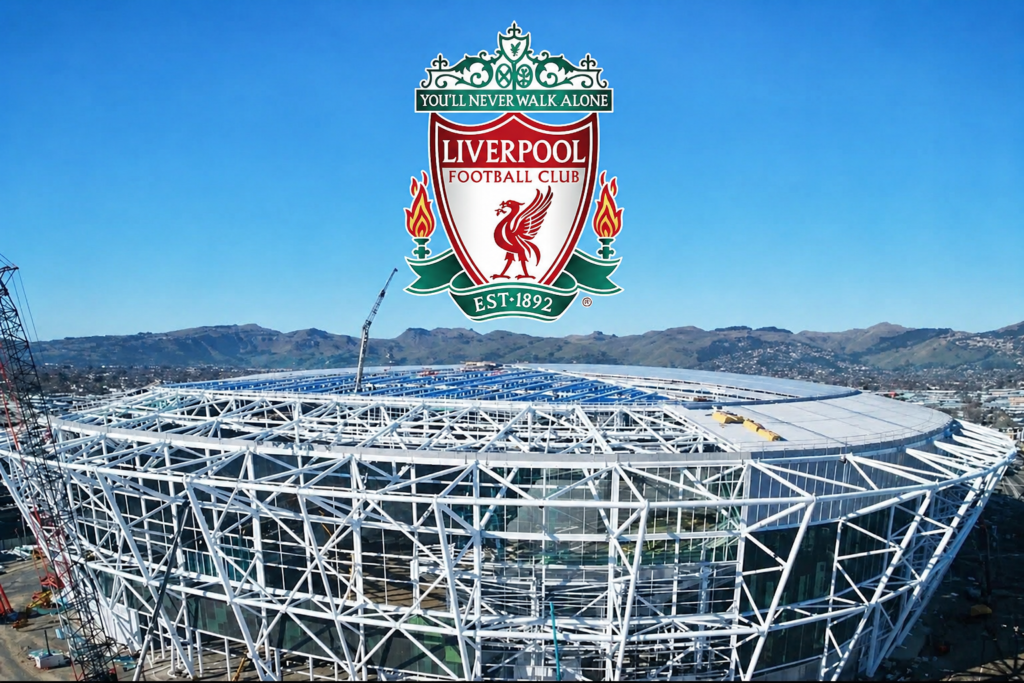
BREAKING: Liverpool greenlights unprecedented $5.9 billion stadium renovation and expansion project
In a move that has stunned the global football community, Liverpool FC has reportedly approved a monumental $5.9 billion redevelopment and expansion project aimed at transforming Anfield into one of the most advanced sporting venues in the world by the end of 2026.
The announcement, which emerged from an extraordinary board meeting at the club’s training complex, marks one of the most ambitious infrastructure investments ever undertaken in football history. If completed as planned, the project will not only reshape the iconic home of Liverpool FC but also redefine the financial and technological landscape of modern stadium design.
—
A vision beyond football
According to early briefing documents circulated within the club’s executive circle, the project is not simply a stadium expansion but a complete “sports and entertainment ecosystem overhaul.” The redevelopment of Anfield is expected to include:
A massive increase in seating capacity, potentially exceeding 85,000 spectators
A fully retractable roof system designed for all-weather global events
A surrounding commercial district featuring hotels, retail spaces, and fan experience zones
Advanced immersive digital viewing technology, including augmented reality match overlays
A fully redesigned transport integration hub connecting Liverpool city center directly to the stadium precinct
Club officials reportedly believe that Anfield must evolve beyond match-day usage and become a “24/7 global football destination.”
One senior executive described the vision as “a place where football never stops, even when the final whistle blows.”
—
Financial structure raises eyebrows
The staggering $5.9 billion valuation has immediately raised questions across the football and financial world. Analysts suggest the project could become the most expensive stadium redevelopment ever attempted, surpassing previous benchmarks by a significant margin.
While Liverpool FC has not publicly detailed its full funding strategy, early reports suggest a multi-layered financial structure involving:
Long-term institutional investment partnerships
Global naming rights agreements (though Anfield’s historic name is expected to remain in some form)
Commercial revenue bonds backed by future matchday and tourism income
Strategic technology partnerships with major global entertainment companies
Economists are already debating whether the project signals a new era of “super-stadium capitalism,” where elite football clubs operate more like global entertainment conglomerates than traditional sports institutions.
Critics, however, have raised concerns about financial sustainability, warning that such an investment could place long-term pressure on club resources if projected revenues fail to meet expectations.
—
Fan reaction: excitement and concern
Across Liverpool and beyond, supporters have reacted with a mixture of awe and cautious optimism. Social media platforms lit up within minutes of the announcement, with fans debating everything from ticket affordability to the preservation of Anfield’s historic identity.
For many supporters, Anfield is more than a stadium—it is a cultural landmark. Built on decades of European nights, legendary comebacks, and emotional tributes, the ground carries a weight of history that fans fear could be diluted by excessive modernization.
One supporter outside the stadium expressed a common sentiment:
> “We want progress, but we don’t want to lose the soul of Anfield. That’s what makes Liverpool special.”
Others, however, see the redevelopment as a necessary evolution to keep pace with global rivals who have already invested heavily in modern infrastructure.
—
Architectural transformation
Design concepts circulating within the project proposal suggest a radical transformation of the current structure. While the famous Kop Stand is expected to remain central to the stadium’s identity, it will be significantly expanded and technologically upgraded.
Architectural firms involved in early-stage consultations are reportedly exploring:
A continuous bowl-style seating design for enhanced acoustics
Energy-neutral infrastructure powered by renewable sources
Smart seating systems with personalized fan experiences
AI-driven crowd flow management to improve safety and accessibility
The aim, according to insiders, is to preserve the emotional intensity of Anfield while elevating comfort, accessibility, and global broadcasting capabilities to elite standards.
—
Global impact and sporting implications
Football analysts believe that if completed, the new Anfield could become a benchmark for future stadium development worldwide. The scale of investment places Liverpool FC in direct comparison with elite global entertainment projects rather than traditional sports infrastructure.
Broadcasting companies are also watching closely, as the proposed upgrades could revolutionize how live football is consumed globally. Ultra-high-definition immersive feeds, real-time tactical visualization, and personalized viewer experiences are all expected to be part of the new digital ecosystem.
In sporting terms, the club’s leadership insists that the project will strengthen Liverpool’s ability to compete at the highest level for decades to come. Increased matchday revenue, expanded global tourism, and enhanced commercial partnerships are all projected to feed directly into football operations.
—
A defining moment in Liverpool’s modern era
For Liverpool FC, this announcement represents more than construction—it symbolizes ambition on a historic scale. The club, already one of the most successful in European football history, is now signaling its intent to lead not just on the pitch, but in infrastructure innovation as well.
However, the path ahead will not be without challenges. Planning approvals, community impact assessments, financial scrutiny, and preservation debates are expected to shape the coming months.
Still, within the club hierarchy, there is a clear belief that this is a once-in-a-generation opportunity.
As one insider reportedly put it:
> “Liverpool is not just building a stadium. It is building the future of football.”
—
Looking ahead
If timelines remain intact, preliminary construction phases could begin shortly after final regulatory approvals, with completion targeted for late 2026. During this period, contingency arrangements for home matches are expected to be implemented, potentially involving temporary relocation strategies.
For now, excitement and speculation continue to build. One thing is certain: if this $5.9 billion vision becomes reality, Anfield will never be seen the same way again.